
Why Trust and Betrayal Create Stronger Suspense Stories
Trust is one of the most important parts of any relationship. In psychological thrillers, that
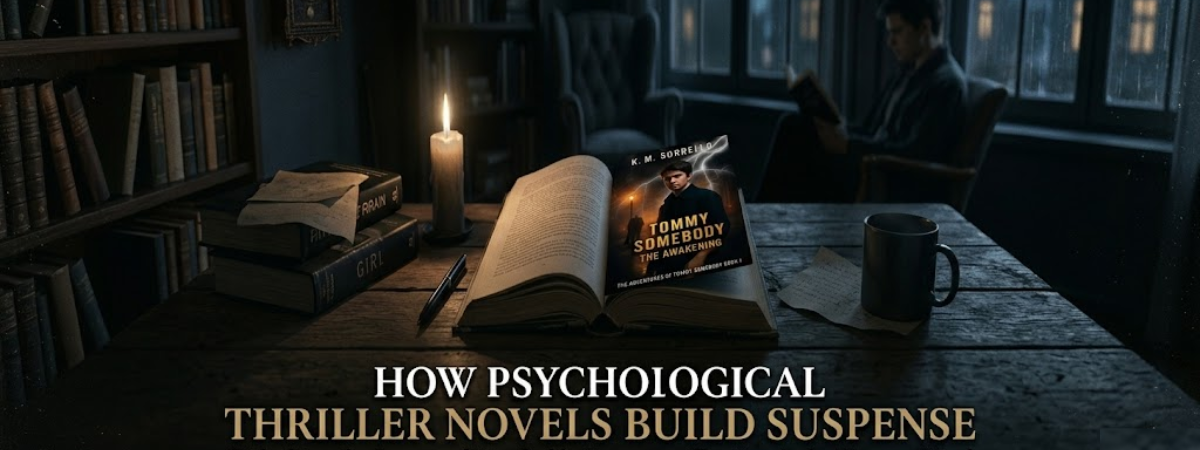
Psychological thriller novels have a special way of pulling readers in. They don’t rely on nonstop action or dramatic set pieces. Instead, they work quietly on the mind building tension through emotion, uncertainty, and the feeling that something isn’t quite right.
A strong example of this storytelling style appears in The Awakening, the first book in the Tommy Somebody series. The story shows how suspense can grow steadily through character experiences, unanswered questions, and rising emotional stakes.
Let’s look at how this type of thriller keeps readers hooked.
Psychological thrillers often start in familiar, comfortable settings. Quiet neighborhoods. Everyday routines. Ordinary people.
That normalcy matters.
When something unusual breaks the calm a scream, a strange feeling, a moment that doesn’t make sense it instantly feels more unsettling. Readers recognize the setting, so the disruption feels personal.
In The Awakening, a peaceful summer morning is interrupted by a scream that only one character seems to hear. Nothing looks wrong. No one else reacts. But the moment plants doubt.
And doubt is where suspense begins.
One reason psychological thriller books feel so tense is that readers rarely get clear answers right away.
Instead, they sit with questions:
When information is incomplete, the mind keeps working. Readers start forming theories. They pay closer attention. Small details suddenly feel important.
That mental involvement deepens the tension far more than fast action alone.
Suspense grows stronger when danger affects someone close to the main character.
A missing stranger is concerning.
A missing friend is personal.
When someone familiar disappears, every moment feels heavier. Conversations become urgent. Decisions feel risky. Emotions cloud judgment.
Readers don’t just want answers they worry about the people involved. That emotional connection drives the tension forward.
Psychological thrillers carefully control what readers know.
Events often unfold through one character’s perspective. Their understanding is incomplete. Their memories are uncertain. Their experiences may not make sense.
This creates gaps in the story just enough to keep readers leaning in.
Too much information removes mystery.
Too little creates confusion.
The right balance keeps suspense tight.
Suspense doesn’t always need dramatic countdowns. Sometimes, simple delays are enough.
A person who should arrive in five minutes doesn’t show up.
Thirty minutes pass.
Then an hour.
Concern slowly turns into fear.
That creeping sense that something is wrong builds naturally and feels realistic. Readers sense the clock moving, even in quiet scenes.
Some of the strongest tension happens inside a character’s mind.
Should they speak up?
What if they’re wrong?
What if no one believes them?
These fears feel human and relatable. Readers understand the hesitation. They imagine making the same difficult choices.
This internal struggle deepens suspense beyond physical danger.
People don’t respond perfectly in stressful situations. They hesitate. They second-guess. They hope for simple explanations.
That realism makes psychological thrillers more believable and more tense.
Readers recognize themselves in those moments and think:
I might have done the same thing.
Sometimes what we don’t see is more frightening.
A shadowed figure.
A brief encounter.
A voice in the dark.
When motives remain unclear, imagination fills the gaps. And imagination often creates stronger fear than detailed explanations.
Switching between viewpoints adds another layer of tension.
Readers may see:
This creates dramatic irony. Readers know more than individual characters, which heightens anxiety with every scene.
These stories tap into everyday fears:
The threats feel possible. The reactions feel real. And the tension builds in a way that lingers.
Psychological thriller novels build suspense through subtle, human-centered storytelling. The tension grows from:
The threats feel possible. The reactions feel real. And the tension builds in a way that lingers.
Why Trust and Betrayal Create Stronger Suspense Stories
Trust is one of the most important parts of any relationship. In psychological thrillers, that

How Unanswered Questions Drive Suspense in Psychological Thrillers
A strong psychological thriller does not reveal everything at once. Instead, it creates curiosity by

Why Unexplained Visions and Intuition Matter in Psychological Thrillers
Psychological thrillers are built on uncertainty. Readers are constantly trying to figure out what is
3 Responses
https://shorturl.fm/OA0OS
https://shorturl.fm/oUWr4